Service Agreement Metrics
Service Agreement Metrics define a list of specific metrics and their thresholds that will be monitored as part of the SLA. To add a new SLA metric, click the + Add metric button.
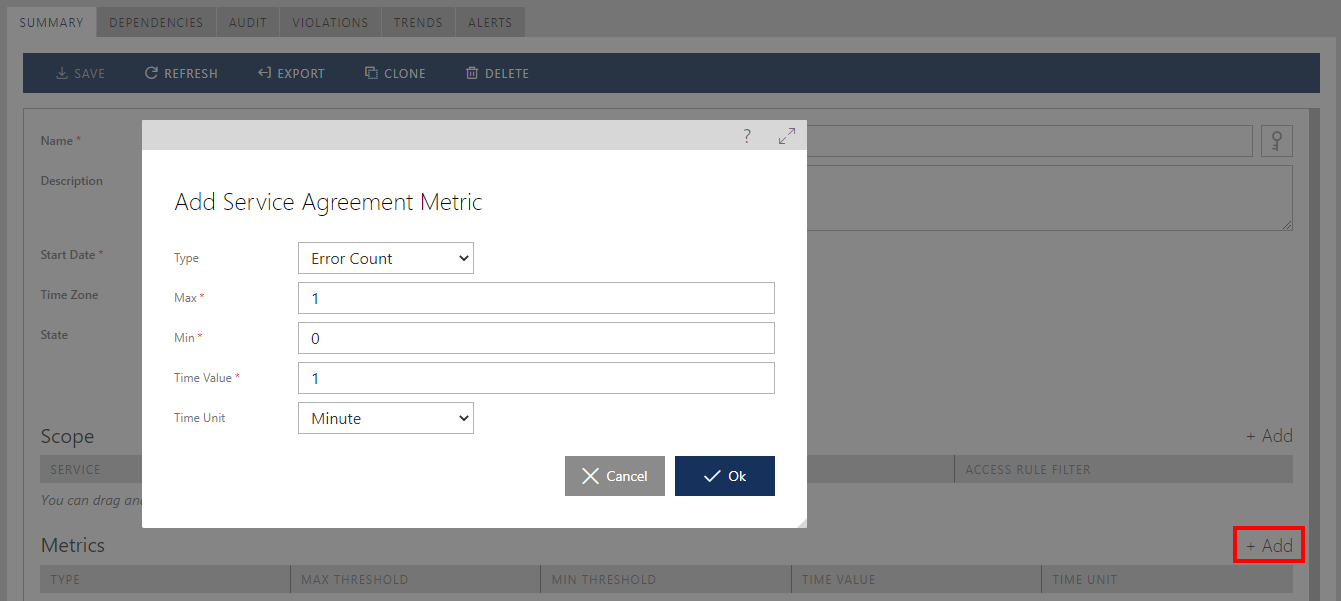
Each metric must be configured with the maximum threshold value, minimum threshold value and the specific period measured in time units. At runtime, Sentinet validates SLA metrics against their assigned thresholds.
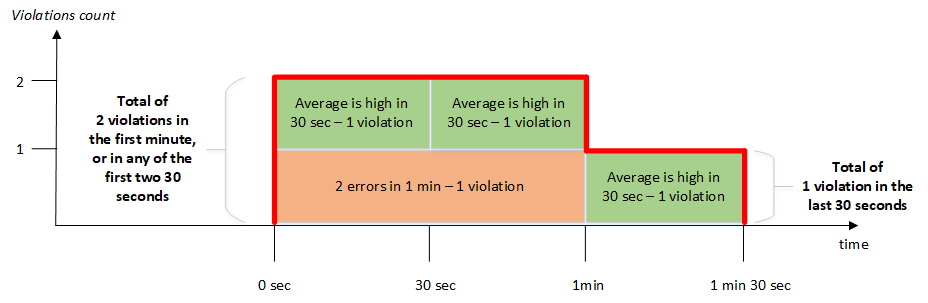
Example: an SLA is configured with the Error Count metric, has a minimum threshold value 0 and a maximum threshold value 1 with a time value of 1 and the unit set at minutes meaning a maximum of 1 error is allowed per minute. If a virtual service (or multiple virtual services) covered by this SLA scope with this metric produces more than 1 error within an observable 1-minute interval, then such SLA will be considered violated once during that 1-minute interval. An SLA can produce at most one violation per metric within the defined metric time interval. If an SLA defines two or more metrics, then an individual metrics' violations are cumulative to an SLA violations count. Let's say in the previous example, an SLA is also assigned the Average Duration metric for a 30-second interval. Suppose there are 5 errors within a 1-minute interval (which will result in one SLA violation in 1 minute), and the average duration was very high during that same minute and the next 30-second interval (results in one SLA violation per each 30-second consecutive interval covering 90-second period). It this case Sentinet generates total of 2 violations during the first minute (sum of 1 error violation and 1 average duration violation) and 1 violation during the last 30-second interval. Consider metrics violations as stacked on top of each other when occurring during the periods that overlap each other and SLA violations minimum observable period (30 seconds in this case) is less or equal to the time interval defined for metric(s).
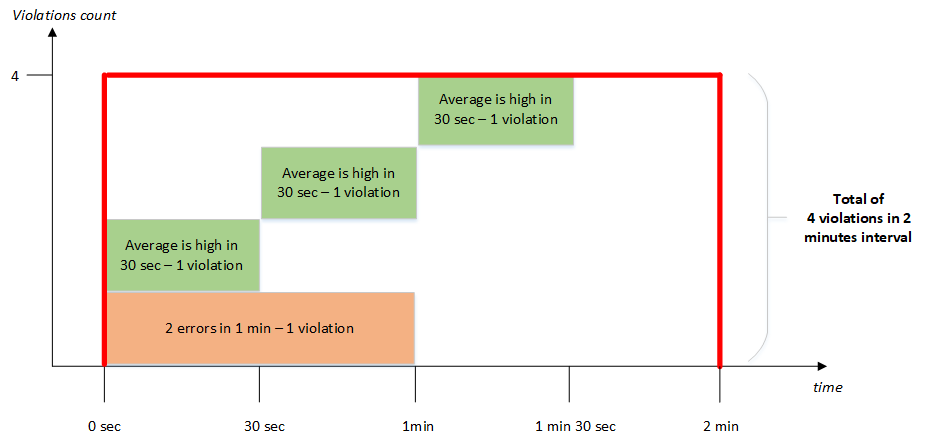
SLA violations are also cumulative (even for the same metric) when violations are observed aggregated over a longer period. For example, suppose that in the previous example minimum observable time interval is 2 minutes, which means that the total number of violations is aggregated over each 2-minute time interval. In this case, a 2-minute interval (that covers 1 min 30 sec above) will be reported with the total of 4 violations, 1 for Errors metric and 3 for Average Duration metric.
Most SLAs are meaningful only in conjunction with a metric's maximum threshold value. Nevertheless, Sentinet also supports a minimum threshold value to allow custom event handling when a minimum threshold also makes sense. Consider the example of an SLA created to monitor service load. The SLA can be configured to start a custom script when the load exceeds the defined threshold and the script can automatically start additional cloud service instances. But when the load drops, administrators want to start another script that will stop these redundant instances. Among other options, this can be accomplished by creating another SLA that monitors service load from the perspective of falling below some minimum value.