Virtual Service Version Details
The Virtual Service Enabled state can be set to No, in which case none of its endpoints will be actively hosted, regardless of any other virtual service settings.
API Key Required flag must be set On if virtual service will be part of an API Product that requires Subscription, otherwise it should be set Off (default settings). This flag cannot be changed if virtual service is already part of an API Product that has the opposite Subscription requirements, in which case virtual service must be removed from the conflicting API Product, or API Product’s Subscription requirements must be changed to make them compatible with the API Key Required flag setting.
Virtual Service Version Base Address
By default, a virtual service is assigned a relative base address that takes the form of a globally unique identifier (GUID).
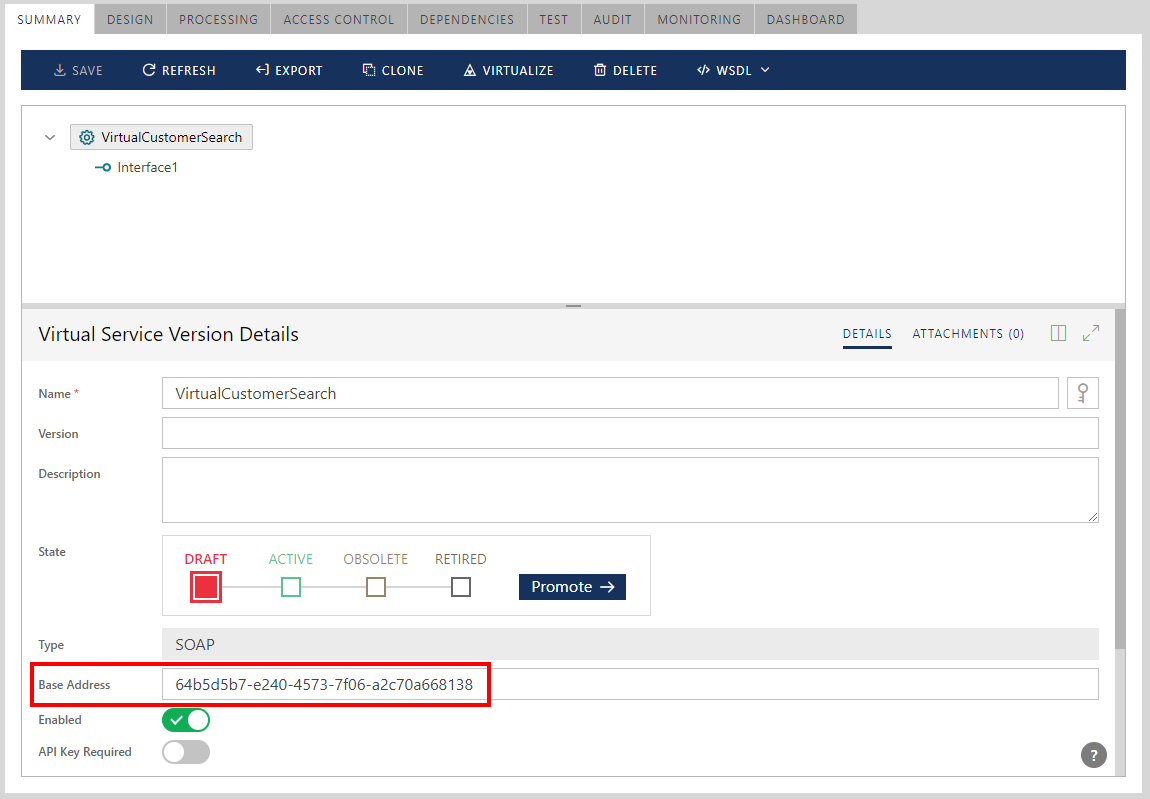
A virtual service base address will be used to construct an effective endpoint address for each virtual service endpoint. An effective virtual endpoint address is constructed in the following form:
http://[machine]/SentinetNodeVirtualDirectory/[BaseAddress].svc/[Endpoint]
http://[machine]/[SentinetNodeVirtualDirectory] is the Node base address of the Sentinet Node that will host virtual service (see the Node Base Addresses chapter above).
[BaseAddress] is the virtual service Base Address that uniquely identifies virtual service within a given Sentinet Node (by default, a virtual service base address is an auto-generated GUID).
[Endpoint] is a unique identifier that uniquely identifies an endpoint within a given virtual service (which is an endpoint address relative to a service version's [BaseAddress]). By default [Endpoint] is empty string for the first virtual service endpoint and an auto-generated GUID for additional endpoints.
Example of a virtual endpoint address with auto-generated [BaseAddress] and [Endpoint].
http://SentinetMachine/SentinetNode/d9f64da-f9fe-47ad-a86c-673440f452ed.svc/4994a742-6be5-4807-a202-96c544eafbd2
By assigning humanly readable virtual service [BaseAddress] and [Endpoint] address parts, Sentinet users can create virtual endpoints with user-friendly and meaningful ultimate addresses. For example:
http://SentinetMachine/SentinetNode/MyVirtualService.svc/wsHttpEndpoint
Note
Nodes of type HTTP(S)-only can have svc-less endpoint addresses (see Nodes Types chapter for more details).
Assigning user-friendly [Endpoint] part of the endpoint address is described in the Inbound Endpoints chapter below. [Endpoint] part is optional and can be omitted, so that virtual endpoint address can be as simple as in the following example:
http://SentinetMachine/SentinetNode/MyVirtualService.svc
For any given virtual service only one endpoint can have empty [Endpoint] address part.